Sonset Projects logo

Decking · Newport · South Wales

Decking built on a frame that lasts.

New timber and composite decking across Newport and South Wales. Level or raised, built on a properly set frame with the right footings, so it stays solid and square years after it is laid.

Newport based Free quotations Owner-led service £6m public liability insurance 12-month workmanship guarantee DuraPost Approved Installer Google Guaranteed

The frame is the deck

Boards are the part you see, but the frame underneath is what decides whether a deck still feels solid in five years. We set posts properly, space the joists to suit the board and the span, and build in the falls and ventilation that stop water sitting where it should not. Get that right and the surface is the easy part.

We build new garden decking in both timber and composite, level with the lawn or raised to meet a back door, with steps, edging and balustrade where the drop calls for it. On sloping or awkward ground a raised deck is often a cheaper and cleaner answer than excavating for a patio.

  • New timber decking, treated and fixed to last
  • Composite decking where low maintenance matters most
  • Level decked areas and raised decks with steps
  • Proper frames, footings, spans and ventilation
  • Decking repairs where the frame is still sound

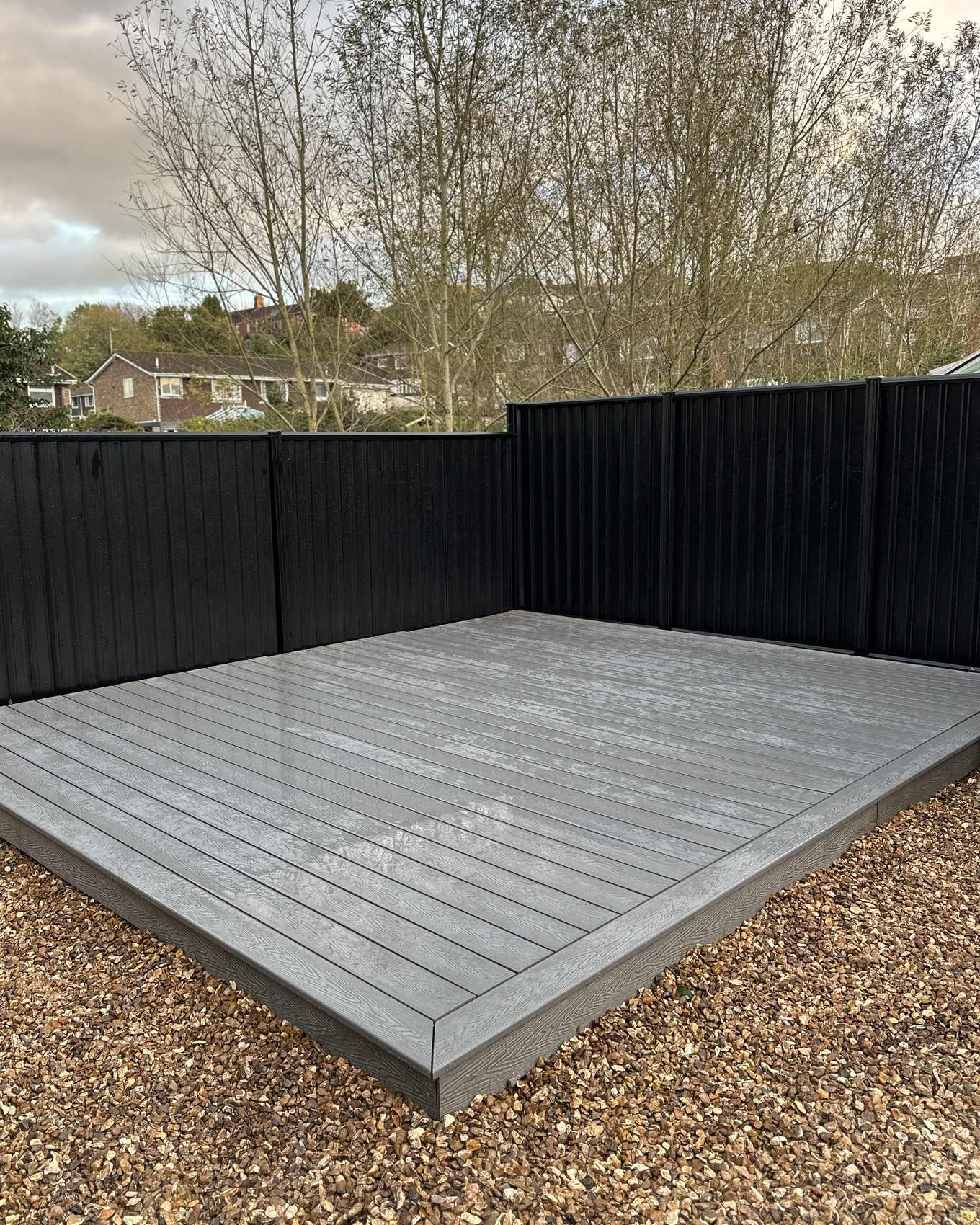
Grey composite decking in a garden with black boundary fencing.

Timber or composite

Both are proper options. Which suits you comes down to how much upkeep you want to take on.

Timber decking

Warm, natural and good value

Treated softwood decking gives you the classic look and the lowest starting price, and it is easy to extend or repair later. It does want cleaning and re-treating every year or two to keep its colour and grip.

Best where you want the natural look and do not mind a bit of seasonal upkeep.

Composite decking

Fit it and forget it

Composite boards are designed to resist rot, warping, splinters and fading, and do not need staining. For most boards a wash down is all the routine maintenance required. It costs more up front and earns it back in time not spent on a deck.

Best for busy gardens, families, and anyone who would rather use a deck than maintain one.

Decking as part of a bigger project

A deck rarely sits on its own. Most of ours go in alongside a new patio for dining, fresh fencing around the boundary and a gate to match, all set out together so the levels work and nothing looks bolted on afterwards.

If you are thinking about the whole garden rather than one corner of it, we can take the lot on as a single project: clearance first, then levelling and ground preparation, then the decking, paving, sleepers, raised beds and turf in the right order.

Teak composite decking with freestanding garden furniture.

Teak composite decking with freestanding garden furniture.

Teak composite decking viewed along its length.

Another angle of the same installation.

Before · After

Composite decking renewal

Tired timber decking before replacement.
Before
Teak composite decking with freestanding garden furniture.
After

Tired decking replaced with tan composite boards and finished as an outdoor seating area.

See more of our work

Protecting the structure beneath your decking

The visible decking boards are only part of the installation. The supporting frame must be correctly designed, levelled and spaced, with suitable ventilation and drainage.

When composite decking is installed over a timber subframe, protective decking tape is applied to the tops of the joists and vulnerable areas where appropriate. This helps reduce moisture entering the timber through screw holes, exposed surfaces and cuts.

There is little benefit in paying for long-lasting composite boards if the supporting timber frame is left unnecessarily exposed and deteriorates much sooner.

The subframe, fixings and board spacing are selected to suit the particular decking system and installed in accordance with the relevant manufacturer guidance.

Decking questions, answered

Timber or composite decking — which should I choose?

Timber is warmer underfoot and cheaper up front, but needs cleaning and re-treating every year or two. Composite costs more to install and then asks almost nothing of you afterwards: no staining, no splinters, no annual treatment. If the deck is somewhere you will use constantly and you would rather not maintain it, composite usually wins. We will price both so you can compare properly.

Can you build decking on a sloping garden?

Yes, and it is often the best answer on a slope. Rather than digging out and retaining the whole bank for a patio, a raised deck sits on posts and gives you a level platform with far less groundwork. We set the frame out properly and add steps and balustrade where the drop needs it.

How long does decking take to build?

Most domestic decks take two to four days once we are on site, depending on size, ground conditions and whether it is level or raised. Awkward access or a lot of levelling adds time. We will give you a realistic timeframe with the quote rather than a hopeful one.

Do you repair existing decking?

Often, yes. Loose or rotten boards, a wobbly handrail and tired fixings are usually worth fixing. Where the frame underneath has gone, repairs stop being good value and we will tell you honestly that a rebuild is the better spend.

Can decking be part of a bigger garden project?

That is how a lot of our decking gets built. A deck for the seating area, a patio for the dining space and new fencing around the boundary all get planned together so the levels line up and everything is finished in one go. See our garden transformations page.

Thinking about a deck?

Send a couple of photos of the space, your postcode and rough measurements if you have them, and we will come back with an honest price.